New publication in Journal of Physics: Photonics
Post-compression of a Q-switched laser in a glass-rod multi-pass cell
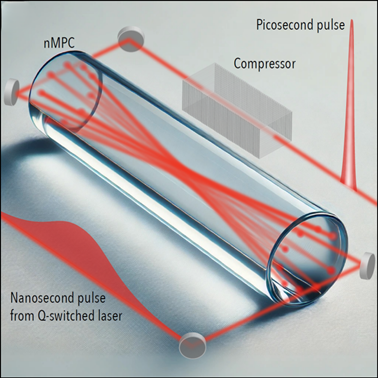
Illustration of the proposed nanosecond MPC concept.
Abstract:
Q-switched lasers are compact, cost-effective, and highly pulse energy-scalable sources for nanosecond-scale laser pulses. The technology has been developed for many decades and is widely used in scientific, industrial and medical applications. However, their inherently narrow bandwidth imposes a lower limit on pulse duration - typically in the few-hundred-picosecond range - limiting the applicability of Q-switched technology in fields that require ultrafast laser pulses in the few-picosecond or femtosecond regime. In contrast, mode-locked lasers can produce broad-band, ultrafast (<1 ps) pulses, but are complex, expensive, and typically require a large footprint. To bridge the parameter gap between these two laser platforms - in terms of pulse duration and achievable peak power - we here propose a Herriott-type multi-pass cell (MPC) based post-compression scheme for shortening the pulse durations of Q-switched lasers down to the ultrafast, picosecond regime. We experimentally demonstrate post-compression of 0.5 ns, 1 mJ pulses from a Q-switched laser to 24 ps using a compact glass-rod MPC for spectral broadening. We verify this result numerically and show that compression down to a few picoseconds is possible using the nanosecond MPC (nMPC). Through spectral filtering approaches, the nMPC suppresses detrimental nonlinear processes such as stimulated Raman scattering, which have set severe limitations for fiber-based post-compression of Q-switched lasers until today. Our results pave the way for cost-efficient and compact ultrafast laser platforms based on Q-switched laser technology.
The publication can be found here.